
Kimberly Waters
‘Clearing landmines in Afghanistan, to the delicate eye operations in remote Australia, the achievements of Andrew Laming MP are impressive and diverse.’
‘Clearing landmines in Afghanistan, to the delicate eye operations in remote Australia, the achievements of Andrew Laming MP are impressive and diverse.’
‘Clearing landmines in Afghanistan, to the delicate eye operations in remote Australia, the achievements of Andrew Laming MP are impressive and diverse.’
‘Clearing landmines in Afghanistan, to the delicate eye operations in remote Australia, the achievements of Andrew Laming MP are impressive and diverse.’
‘Clearing landmines in Afghanistan, to the delicate eye operations in remote Australia, the achievements of Andrew Laming MP are impressive and diverse.’
Man of Diverse Interests
Man of Diverse Interests
Man of Diverse Interests
Man of Diverse Interests
Man of Diverse Interests
From clearing landmines in Afghanistan, to delicate eye operations in remote Australia, Redlands Federal MP Andrew Laming’s career achievements are as diverse and unique as the man himself.
As the Federal Member for the Redland City since 2004, it’s easy to forget there was ever a time Mr Laming wasn’t in politics, but his work history and life story started long before he donned a suit and walked the halls of Parliament House.
Born in Hobart in 1966, Mr Laming’s first career aspirations were as far from the political sphere as possible. “Like most kids I loved sweets, so I wanted to be a pastry chef,” he laughed. “I enjoy my wife Olesja’s home cooking most nights now, but I do repay her with an evening off every now and then, and I get to brush off my pastry chef skills.”
He said conversations around the family dinner table as a boy were lively and sparked an interest in social issues and travel.
“Dad packed up the family when I was four and we moved from Tasmania to Papua New Guinea for four years, so I got used to living in remote parts of the world from quite a young age and learnt not to take what we have in Australia for granted.
“We returned in 1975 and I finished primary school in Mooloolaba and high school in Brisbane.”
Mr Laming dedicated his early 20s to studying medicine, graduating from University of Queensland before heading to London to expand his qualifications in obstetrics and gynaecology. “After completing my medical degree in 1989, I decided to head west and go bush to work in remote hospitals and general practice.”
“I was running a general practice in Gundagai in my second year out when I found an ad in a magazine about serving in Afghanistan with landmine clearing teams. I was the only one crazy enough to apply and I got the job almost immediately.”
As the Russians withdrew from Afghanistan, Mr Laming and a small group caught the last commercial flight in before civil war erupted. “Westerners were assumed to be Russian and enemies of the Afghan people, building that trust was vital. It was a dangerous place at that time, but I was lucky not to be involved in any incidents. Each night on TV our faces were broadcast telling the locals not to shoot, harm or abduct us.”
“In any of those remote parts of the world there’s always a small intrepid group of foreigners working, mostly in the not-for-profit sector, trying to build peace and prosperity and trying to alleviate poverty. It’s actually an inspiring place because the challenges of living remotely are shared, but when you get home it’s hard for people to relate to the lifestyle you’ve been living and work you’ve been doing.“
The passion for helping those most in need which he discovered in Afghanistan, sparked a period of study and travel to some of the most remote parts of the world. “I went and worked for a few months in South Africa, mostly doing sports medicine and running gymnasiums before completing a year working in the NHS system in hospitals, in the UK. It was after that I decided to do some Indigenous work, so I moved to a community in the Northern Territory and studied trachoma, eventually pioneering the use of a breakthrough drug that is now standard treatment for the use of trachoma in children.”
From the Northern Territory to East Timor, Cuba, Kazakhstan, Kyrgyzstan and Madagascar, Mr Laming used his medical skills to help people across the globe. “I worked in a small team to re-establish the health system in East Timor. Probably the most important job I did there was to find all the medical students in East Timor and encourage them to go back to university, and then negotiate with the universities to have them back. At that stage, after the Indonesian withdrawal, there was only 29 doctors left in East Timor.”
“Working overseas in countries dealing with poverty and the aftermath of war, it made me passionate about having a say in how Australia responds to security threats in the developed world, so when I returned to Australia in 2001 I decided to run for the Federal seat of Bowman. When asked to describe himself in three words Mr Laming used persistent, energetic and passionate.” Those three attributes helped him fight for the seat of Bowman in 2001, and successfully win the seat in 2004 and again in 2010 with one of the biggest swings nationwide.
Citing one of his greatest political achievements as helping bring the national chaplaincy program to fruition, Mr Laming said he hoped to leave a strong legacy from his time representing the people of the Redlands. “My greatest personal achievement I hope is going to be my next one, I’m always looking at better and better things all the time, but really as a dad and a husband it’s hard to go past your wife and kids as the single most important focus in your life.”
“My wife Olesja and I met walking through a shopping centre in Latvia, and we struck up a friendship before she agreed to come to Australia for visit… we’ve been together ever since. She’s studied banking and public relations and looks after our two beautiful girls Sophie-Claire, six, and Isobel, two.”
He may have experienced more than most people will do in a lifetime, but that hasn’t slowed Mr Laming down. “I think working as a general practitioner has a lot of similarities to being a politician, as you never know what issues and challenges you’ll be facing each morning when you come to work…
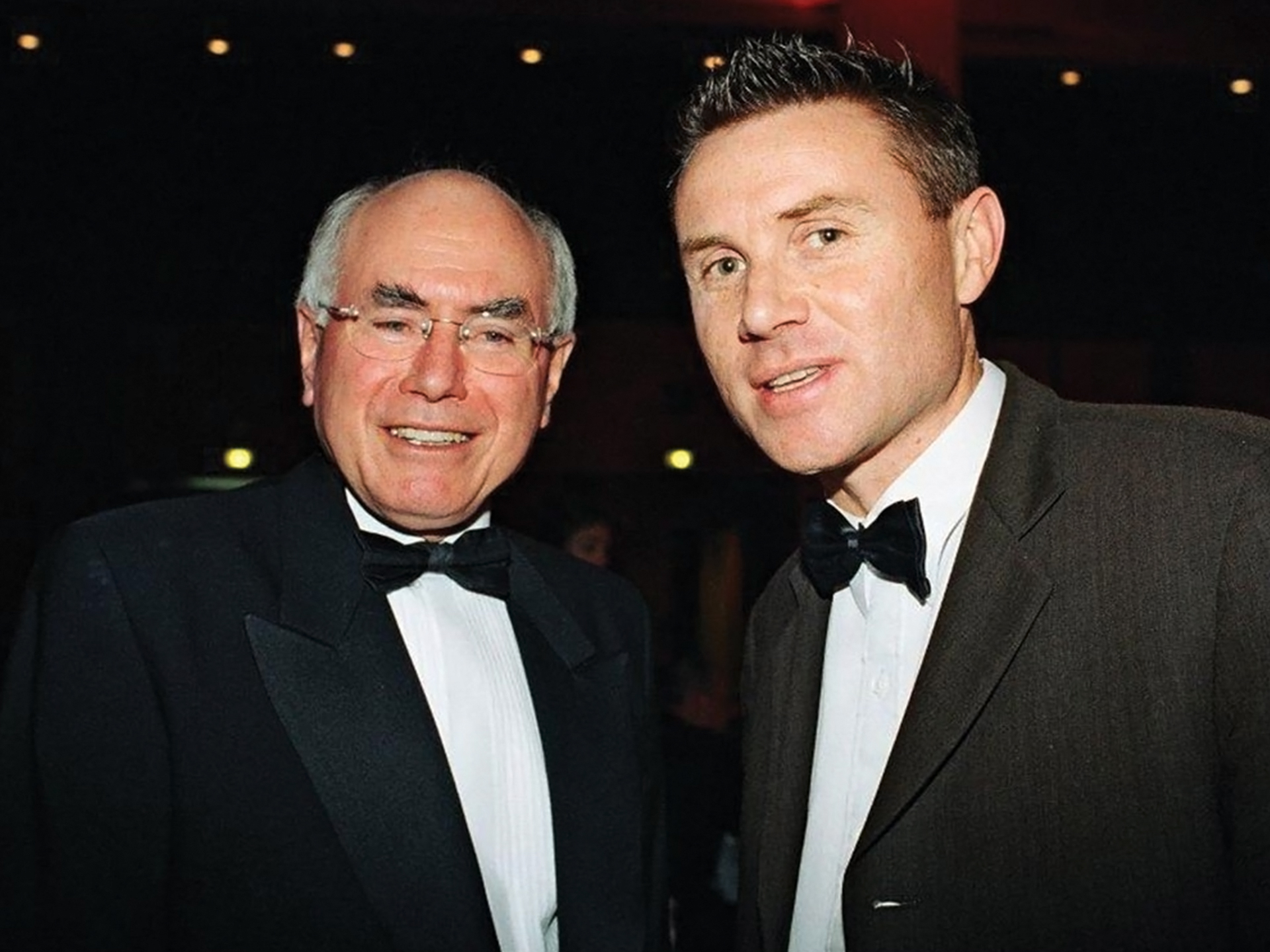
… with Mr John Howard

… with Mr Tony Abbot

… with Family