John Daffy
‘Some days this swirling, demonic temptress guarding the pathway to offshore reefs can appear a veritable saint.’
‘Some days this swirling, demonic temptress guarding the pathway to offshore reefs can appear a veritable saint.’
‘Some days this swirling, demonic temptress guarding the pathway to offshore reefs can appear a veritable saint.’
‘Some days this swirling, demonic temptress guarding the pathway to offshore reefs can appear a veritable saint.’
‘Some days this swirling, demonic temptress guarding the pathway to offshore reefs can appear a veritable saint.’
Tortuous Foaming Monster
Tortuous Foaming Monster
Tortuous Foaming Monster
Tortuous Foaming Monster
Tortuous Foaming Monster
I always have a little chuckle to myself nosing my way towards South Passage Bar in my boat.
For invariably I will already have passed various safety signs telling me not to trip on an uneven path; that I should drive around roundabouts in a clockwise direction; that I should stop at the red light; that a road can be slippery when it is wet; that a boat ramp also can be very slippery; and that creatures in the sea have the capacity to sting, bite or in fact, devour me.
Hundreds of signs confront my everyday life – every annoying one of them there for just two reasons – to constantly reaffirm in our cotton wool society, that if anything ever happens to you, then it must be someone else’s fault; and secondly, that it’s not the fault of the person who put up the sign.
Having adroitly managed not to crash my car or boat into any of the 145 warning signs erected on 145 galvanised posts lining the short 3.1km route from my driveway to the head of the boat ramp, I slip across the bay until I hit the green lateral mark and the northern cardinal mark at the eastern end of the Rous Channel and with it, the gateway to the South Passage Bar.
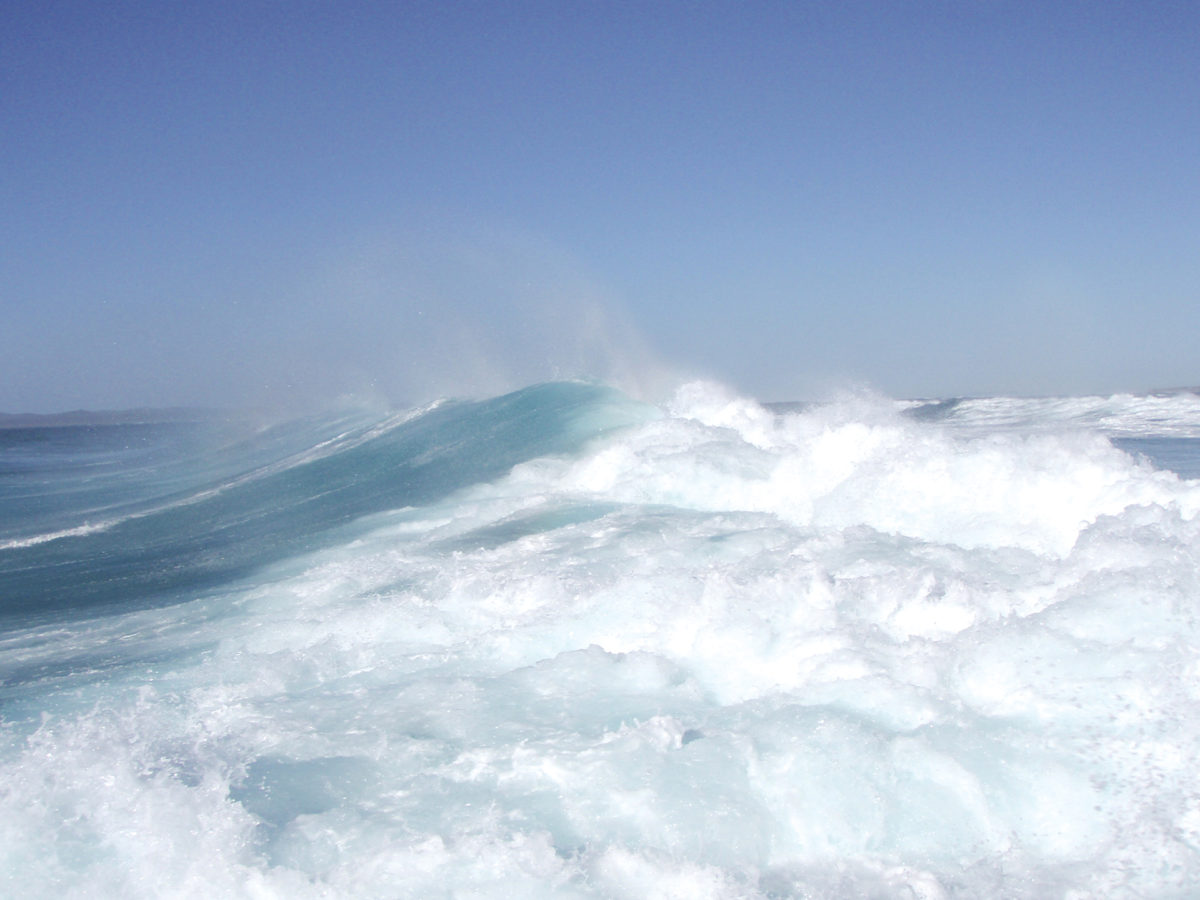
And here she stands – a tortuous foaming, monster of a waterway with a fearsome crashing sound of surf. A devil’s cauldron of white spray bristling at the opportunity to add another boat to its tally of wrecks, over-turned vessels, drowned and near-drowned crews. Yet, not one warning sign in sight.
Mind you, some days this swirling, demonic temptress guarding the pathway to offshore reefs can appear a veritable saint – not even showing a slip of white through her colourful deep blue and light green skirting waters.
But like the Sirens of Greek mythology enticing Jason and his Argonauts, or Odysseus to sail perilously closer, the South Passage Bar is a trickster and not be treated with anything less than the utmost respect.
I’ve grown to love the South Passage Bar, her different moods, the way channels open up and close out, the contrast of pearlescent white foam against a yellowing dawn, her blues, greens and greys, how sometimes she will offer up a clear path, and others when she simply doesn’t want you to head offshore.
It is here, through this gap measuring roughly four kilometres stretching from Reeders Point on the southern end of Moreton Island and Amity Point (aka known as Rough Point) on the northern-western tip of North Stradbroke Island, that the moon sucks the tidal flow westwards out of Moreton Bay, twice a day, to crash headlong into the prevailing incoming swells of the Coral Sea.
Revered bar crossing and boat handling instructor Bill Corten from Ormiston, is one of the few who can claim to have really tamed her. Bill’s knowledge of the South Passage Bar, his boat handling skills, precision helmsmanship and total focus on safety, have taught many boaters how and when to navigate the South Passage Bar. He’s plucked untrained “She’ll be right” punters from her waters; he’s taught countless others how to cross her safely.
The bar changes daily – a tidal change can make it different, a storm can change a channel, a severe blow can help move thousands of cubic metres of sand from one place to another – it’s a constantly changing marine kaleidoscope.
And they’re changes which Bill monitors almost on a daily basis.
If I haven’t crossed the bar for a few weeks, it’s not unusual to find myself phoning Bill for the latest update – a quick call to download the latest visual image into my head of what I can possibly expect, when I head out the next morning.
There are some golden rules to crossing the bar, but reading the theory is no way to learn. Sure, someone can give you the waypoints for a channel that is currently working, but that will not teach you how the bar works.
It won’t teach you how this stunningly beautiful, but potential Mistress of Misery demands you carefully navigate ‘the shingles’ then the northern entrance (if it is open) and outer banks if you are to make your way out via the Moreton Island end.
Or cover several kilometres to fully complete the run-up to and then the horseshoe which is now the shape of the middle channel (it used to be a ‘Z’ shape); or how the channel has shifted from the southern side of the Rufus King wreck to the northern side and now back to the southern side again – if it’s there at all – while you are trying to skip through the shallows and clear Amity Point.
It doesn’t matter that a decade ago you simply headed north as far as you could, caught the southern end of Moreton and then aimed at Mt Tempest to run north-westwards and avoid the outer bank.
Or that you used to hug Amity’s shore to find the break through the surf, and then run inside of the Rufus King wreck before aiming back at Flinders Beach.
What does matter is that you understand this stretch of water changes by the hour, the day the week month and year.
Its beauty and power are inter-twined. A personal achievement of some note if you can acquire the skill, confidence and knowledge to cross it in most conditions suitable for fishing; but a place a great risk for the inexperienced or gung-ho.
Mind you, there’s no sign on a galvanised pole to tell you that …
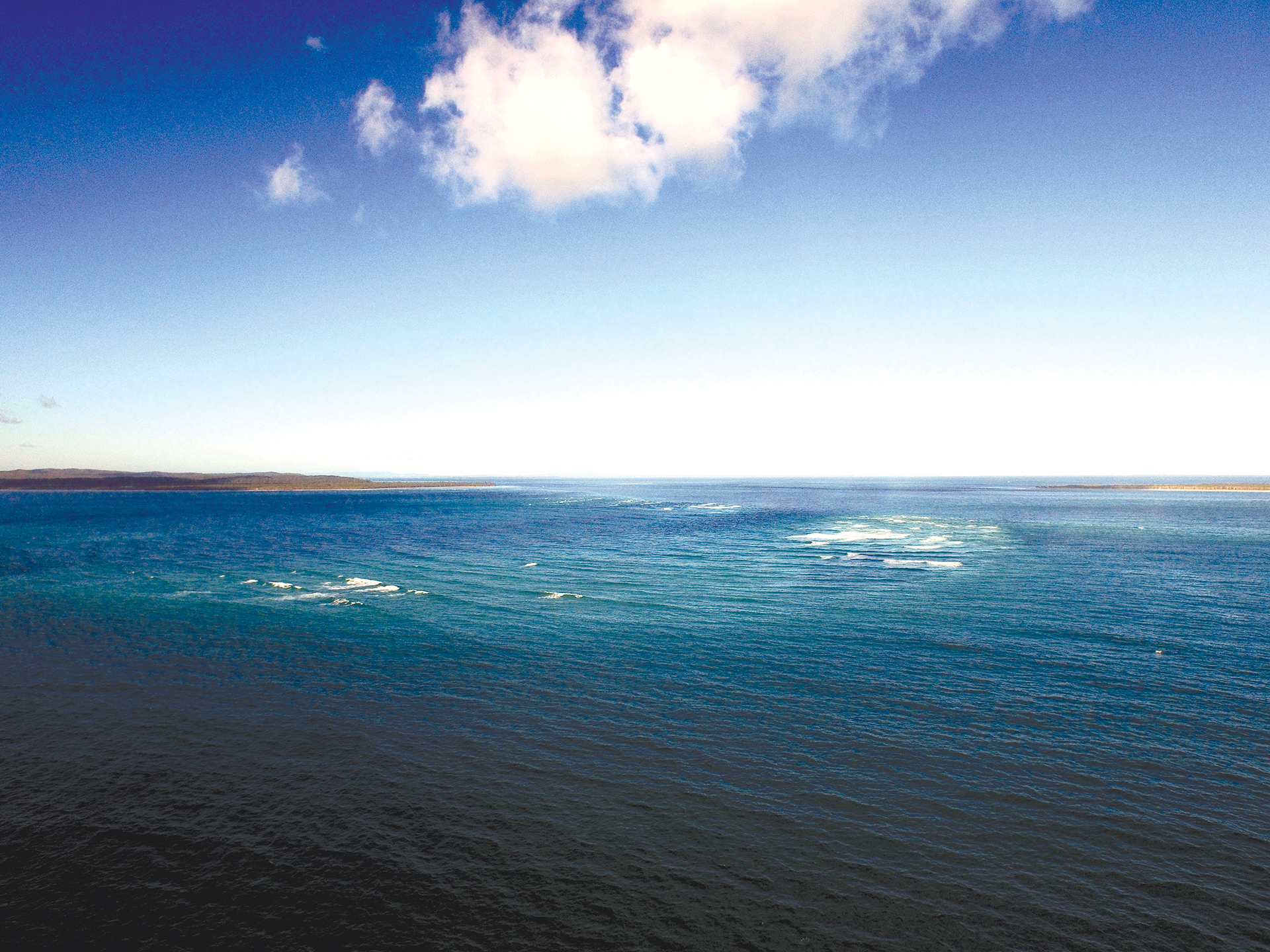
Calm, South Passage Bar
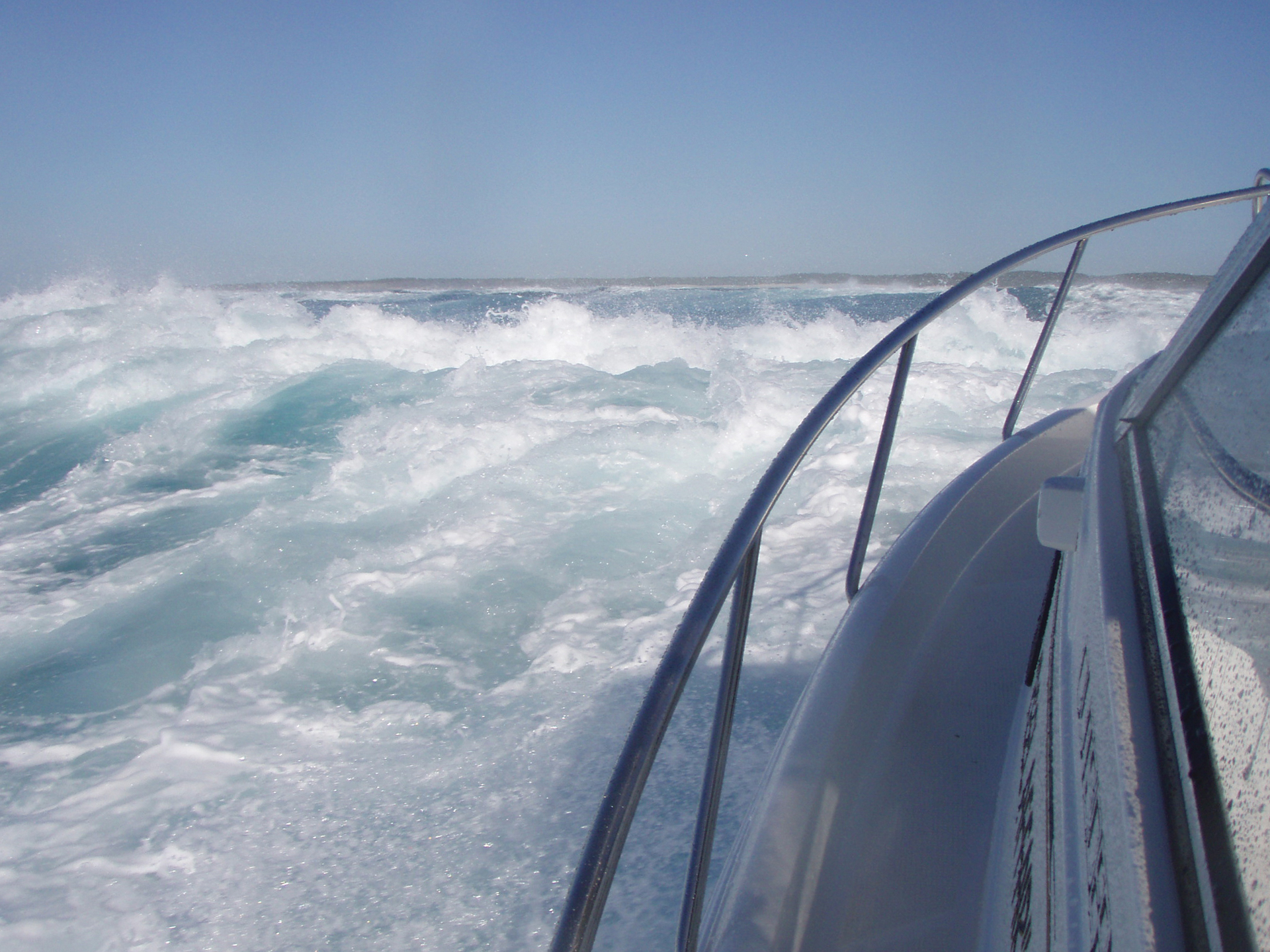
Not So Calm, South Passage Bar