John Daffy
‘It doesn’t matter whether you are a land-based or a boat-based squid predator, you can snag a cephalopod, provided you are chasing them in clear, clean water.’
‘It doesn’t matter whether you are a land-based or a boat-based squid predator, you can snag a cephalopod, provided you are chasing them in clear, clean water.’
‘It doesn’t matter whether you are a land-based or a boat-based squid predator, you can snag a cephalopod, provided you are chasing them in clear, clean water.’
‘It doesn’t matter whether you are a land-based or a boat-based squid predator, you can snag a cephalopod, provided you are chasing them in clear, clean water.’
‘It doesn’t matter whether you are a land-based or a boat-based squid predator, you can snag a cephalopod, provided you are chasing them in clear, clean water.’
Edible Bait
Edible Bait
Edible Bait
Edible Bait
Edible Bait
I started eating bait as a kid. I loved it and fish, wow, the moment I tasted it raw, it was gastronomical game on.
My mother thought it a little strange that as five-year old, I wanted my peas, beans, sprouts, carrots – virtually every vegetable, raw. Before I hit my teens, I had added fish, beef, sea scallops, abalone, and oysters to the raw list, but when I decided that blue pilchards and whitebait tasted sensational, well, I think the folks thought there must have been some sort of mix-up in the maternity ward. Clearly my folks had been dudded.
This was Melbourne in the 1950’s and early 1960’s – not some trendy, affluent near-Brisbane suburb in 2015 where babies are ferried around to highly-priced playgroups in pushers made by Jeep, steered by gym junkie mothers wearing electronic gizmos and brand name Lycra and joggers that represent nearly a week’s wages to some people.
No this was Melbourne – even before the first pizza shop had opened – Toto’s in Lygon Street Carlton which is still there today.
Fortunately, I had mates from an eclectic mix of nationalities and even more fortunately, some of their mothers, nannas and aunts were Greek, Italian, Egyptian, Lebanese, Persian, Cypriot and Turkish as well as from quirky little Baltic nations.
That meant they knew how to cook – but more importantly, it also meant they knew how not to cook.
Somewhere in that rich tapestry of culture, I first tasted calamari. I’m disappointed that I can’t remember the first time I ate it, but it sure didn’t come from a fish and chippery where as a kid “Six of chips, six of cakes and a piece of Mercury, sorry Mr Dounis, I meant flake” was the standard order for an Aussie kid.
Calamari. Heaven in a hood even after having been cooked. Sensational cephalopods. The world’s most edible bait – not to be placed on hooks and wasted on fish, but to be consumed by humans within hours of having been caught.
And the great news is that some of the best edible bait in the world – those cephalopods, squid or calamari, call them what you will, are located throughout the shores of Australia and in abundance.
It doesn’t matter whether you are a land-based or a boat-based squid predator, you can snag a cephalopod, provided you are chasing them in clear, clean water.
Day or night, it doesn’t matter; but clear water, it counts for everything.
Therefore, you will not be surprised to know that you can catch them virtually year around along the crystal-clear western side of Moreton Island. But when it comes to bayside suburbs, autumn and winter will be more productive.
Less rain, less run-off, less wind, less current running and greater protection from the westerly winds.
In terms of Moreton Island try from Lucinda Bay southwards over the shallow weed beds.
For land-based anglers, seek out the rock walls and structures.
Guys like Luke Deighton pictured here with a quality tiger squid, have honed their skills with people like Paul McGuren from Wakerley who is a driving force from the Moreton Bay Squid Fishing Group.
Those skills include ‘sighting’ the squid – they look for the squid and target them. At night, they wear bright, head-mounted torches and quietly work their way along rock walls and down boating ramps looking for the squid. Once sighted, they flick out their squid jigs – beyond the squid and retrieve the lures.
Unlike the anglers who simply drop a squid jig over the side of a foreshore jetty and hope for the best, the best squid sighters physically look for the delectable critters. They might work from Raby Bay to Manly in an evening, pulling in a few here, a few there.
Yamashita and Yo-Zuri jigs in the 2.5 size make a good starting point when teamed with a 2-4kg spinning rod around 2.4 metres long with a 2,000 or 2,500 spinning reel. Braid of around three or four kilograms running to metre or so of fluorocarbon leader is all you need with the squid jig on the end.
Jigs are prawn shaped with a flat, inbuilt weight to make them sit realistically in the water. They have a cloth outer wrap with a foil appearance and come in a range of colours.
While there are no ‘hard and fast’ rules, you might like to start with a gold coloured foil in the morning, a silver foil in the middle of the day and perhaps a red foil at night.
As winter comes on, you can also leave out a squid shaft jig floater with a pilchard on it while fishing for whiting. Any tackle shop will be able to sell you the squid shaft jig. Insert it lengthwise through the pilchard, allowing the tail to rest near the upturned barbs on the end. Suspend it perhaps a metre below the surface of the water under a small float and just let it bob around while you are chasing your whiting.
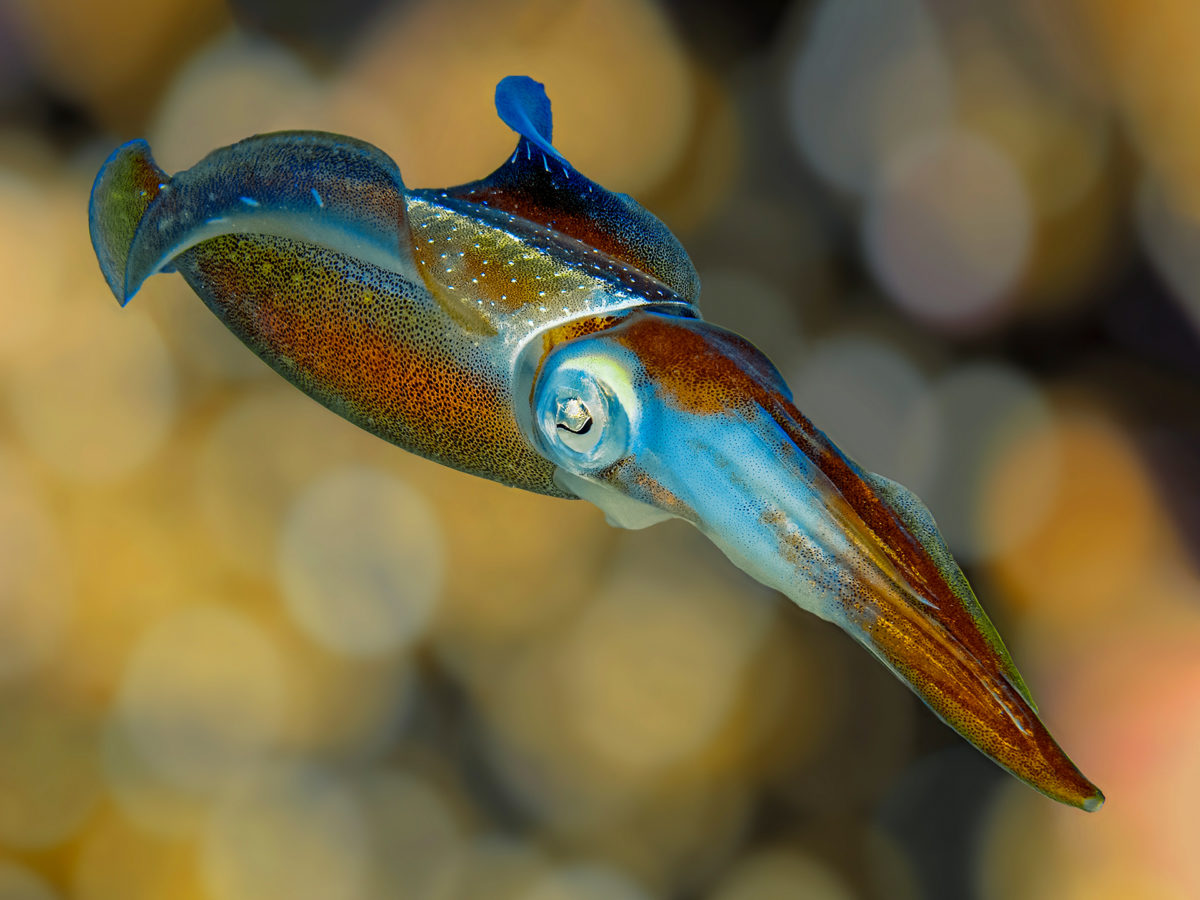
While there are a broad range of species in Moreton Bay, including the Broad squid, Slender squid, Southern Calamari, the Diamond Back (which can grow well over a metre long), it is the Northern Calamari or Tiger squid (Sepioteuthis lessoniana) and the smaller, Gould’s arrow squid (Nototodarus gouldi) which are the most prevalent.
Arrow squid are typically around the 10-20cm mark while tiger squid which have the distinctive dark banding, grow large – ones running to 800 grams are pretty common.
Arrow squid are typically around the 10-20cm mark while tiger squid which have the distinctive dark banding, grow large – ones running to 800 grams are pretty common.
Squid fishing – get your teeth into it…
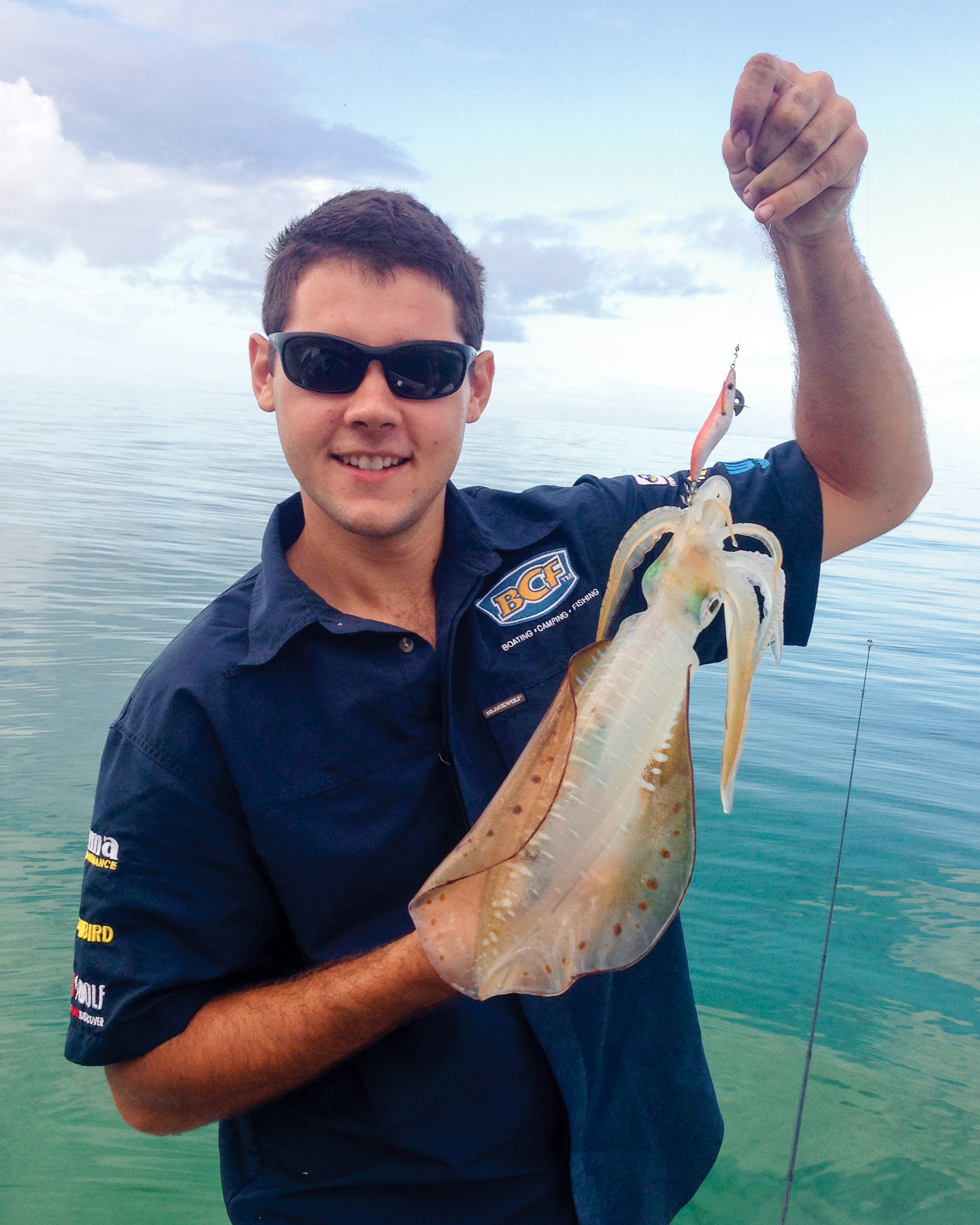
Tiger Squid with Luke Deighton