John Daffy
‘The recreational bag limit for snapper in Queensland is 5 at 25cm, New South Wales is 10 at 30cm, Victoria is 10 at 28cm with 3 exceeding 40cm, Tasmania is 5 at 30cm, South Australia is 15 at 38cm with 6 exceeding 60cm, Western Australia is 2 at 50cm and Northern Territory is 5 with no size limit.’
‘The recreational bag limit for snapper in Queensland is 5 at 25cm, New South Wales is 10 at 30cm, Victoria is 10 at 28cm with 3 exceeding 40cm, Tasmania is 5 at 30cm, South Australia is 15 at 38cm with 6 exceeding 60cm, Western Australia is 2 at 50cm and Northern Territory is 5 with no size limit.’
‘The recreational bag limit for snapper in Queensland is 5 at 25cm, New South Wales is 10 at 30cm, Victoria is 10 at 28cm with 3 exceeding 40cm, Tasmania is 5 at 30cm, South Australia is 15 at 38cm with 6 exceeding 60cm, Western Australia is 2 at 50cm and Northern Territory is 5 with no size limit.’
‘The recreational bag limit for snapper in Queensland is 5 at 25cm, New South Wales is 10 at 30cm, Victoria is 10 at 28cm with 3 exceeding 40cm, Tasmania is 5 at 30cm, South Australia is 15 at 38cm with 6 exceeding 60cm, Western Australia is 2 at 50cm and Northern Territory is 5 with no size limit.’
‘The recreational bag limit for snapper in Queensland is 5 at 25cm, New South Wales is 10 at 30cm, Victoria is 10 at 28cm with 3 exceeding 40cm, Tasmania is 5 at 30cm, South Australia is 15 at 38cm with 6 exceeding 60cm, Western Australia is 2 at 50cm and Northern Territory is 5 with no size limit.’
Responsible Fishing
Responsible Fishing
Responsible Fishing
Responsible Fishing
Responsible Fishing
We have king snapper, red snapper, gold band snapper, Bowen snapper, frying pan snapper, juvenile snapper, squirey snapper, snappery squire, flame snapper and snappers that don’t look anything like snappers.
So rather than giving you the edge to catching snappers which are job fish, or snappers which are sea perch and nannygai, or snappers which are emperors, or ones which look like deep sea Siamese fighting fish on steroids, we’ll just stick with snappers which are real snappers – those of the species Chrysophrys auratus.
They’re the ones that start out as (here we go again), Cockneys, rats or pinkies, before turning into squire, then snapper or knobbies and finally, old man snapper sporting a hump on the nape of the head.
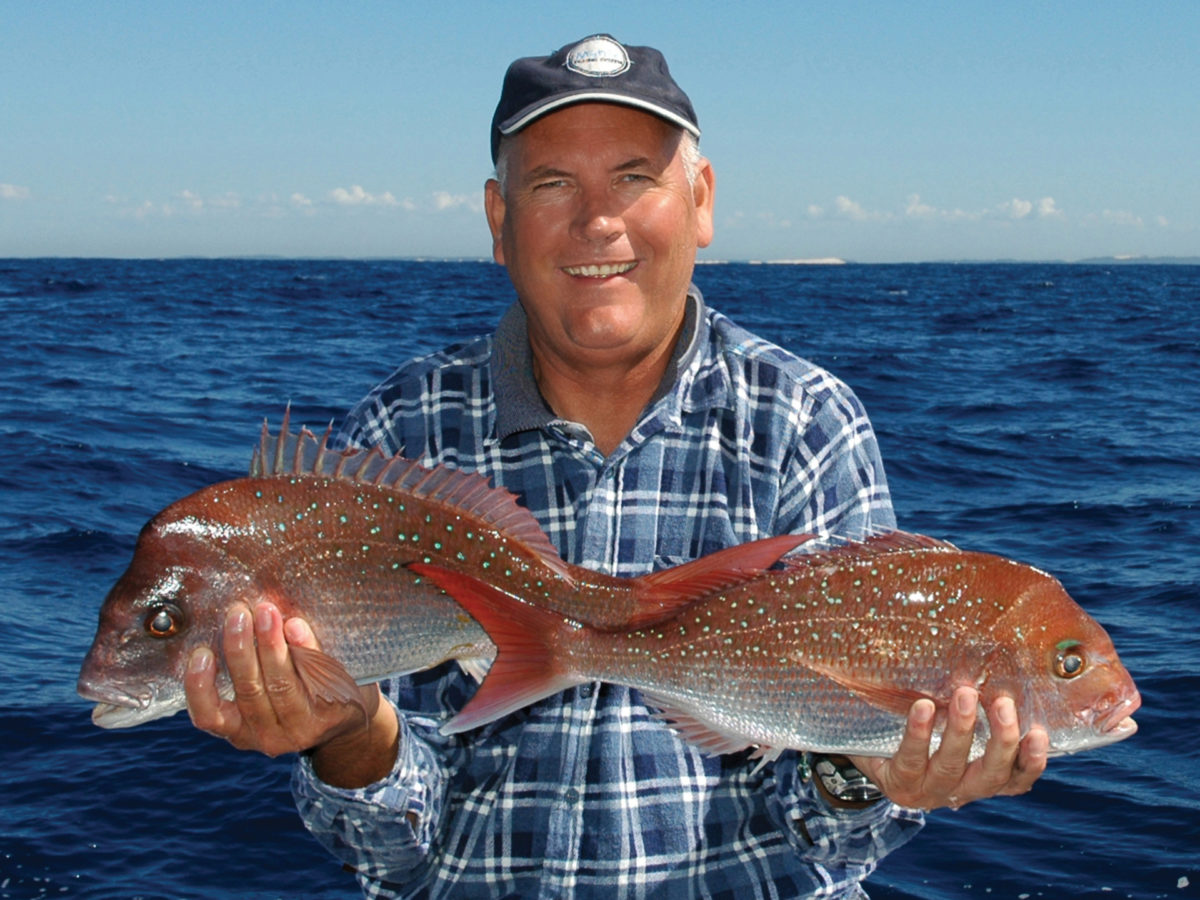
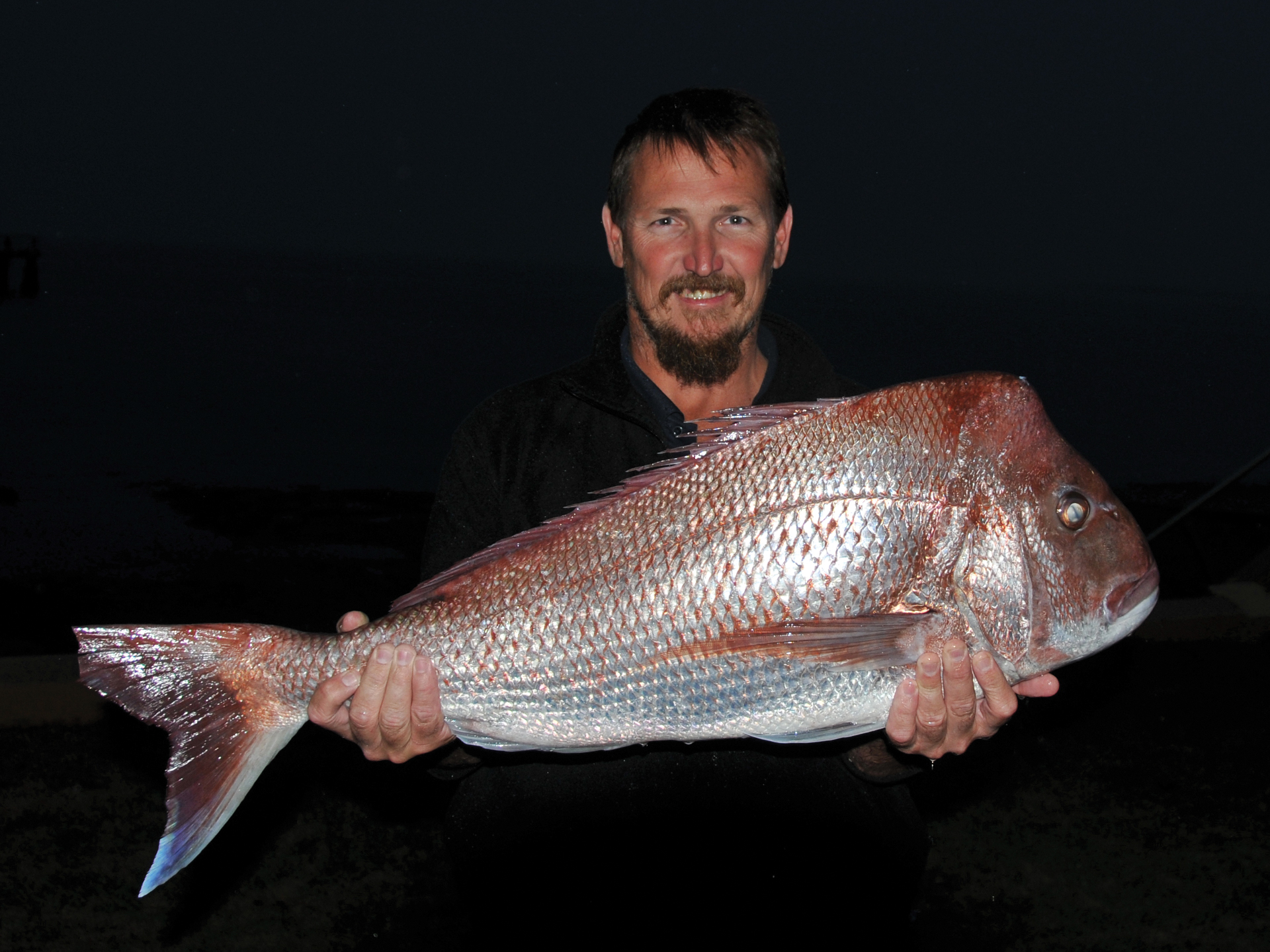
Chrysophrys auratus is a magnificent pinkish-red scaled creature with iridescent blue spots and is correctly regarded as one of our best table fish.
And, while they can be caught all year round, it is when the mercury starts to fall, that keen snapper fisherfolk get excited.
Smart locals know you don’t have to venture to offshore reefs to catch great snapper.
Inside Moreton Bay, Peel Island with its natural reefs and close proximity to a network of artificial reefs nearby; the eastern side of Mud Island; rocky outcrops off the mainland stretching from Scarborough in the north of the bay, southwards to Wellington Point; even the residential canals as well as the drop offs forming the bay’s labyrinth-like network of channels, form likely snapper hunting spots.
There’s a local tax agent Dave Anderson who has achieved near guru status for catching XOS sized snapper from his diminutive tinnie and modest outboard.
This is a man who is always prepared to creep out in the middle of a bitterly cold, moonless night to stealthily work his way across the shallows.
He’ll be back at the ramp just after dawn with a trophy sized snapper and several smaller ones as well.
Dave is a fan of Z-man plastics – he regards them as a premium bait. Despite Dave’s encouragement, I’ve never had much success with them but then again, it’s one thing to have a plastic on the end of your line, it’s an entirely different matter how you impart movement to make that Z-man come alive and trigger the attack reflexes in a snapper.
Unless you are a specialist like Dave in a particular technique, you can markedly improve your results by mixing up the baits. Have a blue pilchard floating around in the shallows as well as a small live bait or alternatively, just leave a strip bait dancing in the natural flow of the water. You’ll see many offshore snapper fisherman sending down double loop Paternoster rigs with sinkers ranging anywhere from 8’s (referring to eight ounces) through to 16’s (a pound or roughly half a kilogram).
Sometimes, conditions will require an even heavier sinker to take live baits, flesh baits, pilchards, squid and others down to the target zone which might be up to 100 metres deep.
Don’t be frighted to use whiting frames they make great baits and stop complaining about catching pesky grinners – whip a fillet off one side of a grinner and send it back down.
Two boats and many years ago, I changed my snapper fishing strategies and the results improved immediately. Instead of paternosters, I moved to floating down the baits.
Typically, that means running a small ball sinker directly on to one or two 7/0 hooks baited with either a small livie (slimey mackeral are best, otherwise, a yakka is okay). Other options are a single pilchard, a slash of flesh bait or my second-favourite, a pilchard inserted halfway up the skirt of a small bay squid.
With the live bait, just a very small ball sinker, size number two or less – just to get the livie headed down in the right direction. With the others, again a smallish ball sinker perhaps to a size four or five. The reason is pretty simple – big snapper are smart snapper.
They’ve seen their environment raining with leads, hooks, swivels and all manner of Chinese-made apparatus – and they’ve seen the younger, less educated fish, fall victim frequently.
They’ve learned to avoid such obvious traps.
So, when you send down a slow bait, floating gently on the current, it appears more natural and the larger fish says: “This one’s for me.”
A bait that falls more slowly in deeper water also spends more time in the water column.
If you study your sounder closely, you’ll see that the larger fish often tend to sit a little higher in the water column, than the smaller fish. Even if there is a pronounced pinnacle laden with fish, your larger ones will be sitting perhaps five or ten metres higher up the water column.
That’s something understood by local guys like Brett Seng and Troy Dixon who regularly win the snapper division of fishing tournaments.
In fact, it was Brett who more than a decade ago, tipped me into using five metres of 20-pound Shogun Ice Blue monofilament line tied directly to my main braid line, when fishing for snapper.
No hardware, no distractions. It has worked a treat.
In terms of braid, my personal preference is Tasline spectra line and specifically, the blue and white speckled version that is made in New Zealand to the exact specifications of a New South Welshman named Paul Van Gaal who manufactures and designs industrial and medical testing instruments …
Snapper with Richard Love